|
|
THE
STATION
Brunel began work on the South Devon Railway in
1844. Due to the steep inclines involved in the route, he decided to
adopt the new atmospheric system. This meant that the locomotives did
not have to carry heavy fuel as they would be drawn along the track by
the vacuum created in large pipes alongside the railway line. Pumping
stations at three mile intervals create the necessary vacuum.
The system was installed as far as Totnes but was never used beyond
Newton Abbot. Continual problems meant that the whole system was
abandoned in 1848. The pumping house at the north end of Dawlish station
remained until 1868, when the goods yard was created to ship produce
such as locally grown violets to London.
The first station was a simple temporary wooden building on one side of
the track only. In 1860s, fire places replaced stoves in the waiting
room and a station master’s office and parcel store were built. A new
station was being planned in 1872 but the wooden one was completely
destroyed by fire in summer of 1873.
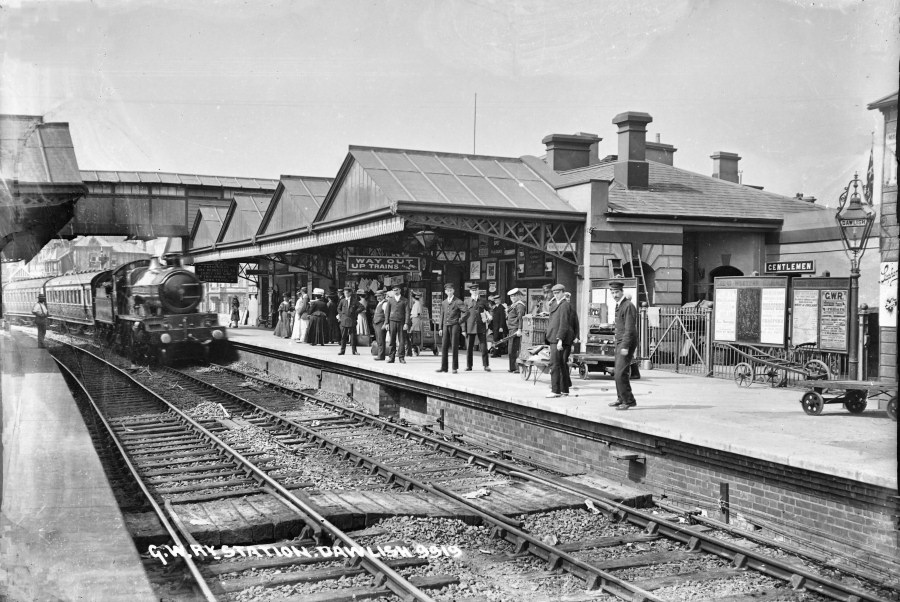
The new stone built station opened in April 1875. The Booking Hall had a
luggage lift up to platform level. The Parcel Office was next to the
Booking Hall but was inconvenient and relocated to the platform level
and is now a café. There was a first class waiting room, which became
the ladies’ waiting room, and a second class waiting room which became
the general waiting room. In addition, there was the stationmaster’s
office and a telegraph office. The “water closets” were run by Mr Pessel,
who kept them clean and charged 1d for their use. On the down side there
were separate lavatories for first class ladies, second class ladies,
and gentlemen. Third class ladies were not catered for.
There are stairs leading up from the beach side to the down line
platform but they have been bricked up. Wide canopies covered the
platforms which had a bookshop and newsagent on the up line. These were
replaced in 1961.
Dawlish station was built when the South Devon Railway was thriving and
is subsequently one of the best that they built.
|
|