|
|
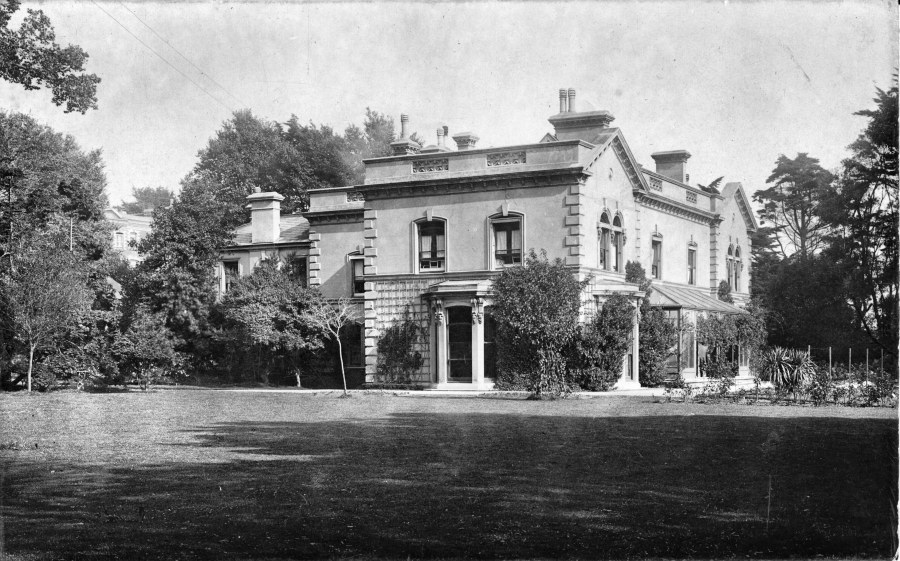
LANHERNE (FORMERLY SEAGROVE)
Before Dawlish became a ‘fashionable watering
place’, a house was built here in the style of pure Strawberry Hill
Gothic. It was known for over a hundred years as Sea Grove but we know
it as Lanherne. It was built around 1786 by William Watson born in
Middlesex in 1744 he went to Cambridge after attending Charterhouse,
wrote ‘A Treatise on Time’ and was knighted in 1796. We have a good
description of the house by the Rev. John Swete who travelled all over
Devon writing and sketching as he went:
“Having descended a steep hill, I enter’d the Village of Dawlish....
Here the most conspicuous object was a house erected by a Mr Watson
after the Gothic style of architecture, exhibiting in its front a kind
of arcade with columns and pointed arches decorated with escutcheons and
network pinacles forming one of the most pleasing specimens of the
Gothic manner I ever…The gardens that surrounds the house is curious
having a variety of Exotic plants in it, for Mr Watson is not only a
Botanist but hath made considerable advances into natural history.”
After Sir William’s death in 1825 his widow remained in the house. And
then in the early 1840s the building of Brunel’s atmospheric railway
started along the coast, which some people in Dawlish welcomed. Others,
including Lady Watson, had other views. Unluckily for her, her property
was very close to the proposed line and although she could not actually
see it from the house she could probably hear all the noise and suffer
the dirt and smoke from the engines.

By 1865 a Mr. Leon Solomon had bought Sea Grove although he also owned a
house on Westcliff (formerly Sunrise, now Devon Court). He was born in
Poland but was a British Subject and described himself as a
‘Capitalist’. There were two rumours that surrounded his family. The
first is that he had 25 children! The other rumour was that some of his
family emigrated to America and changed their name to Simpson. It was a
member of this family who was the second husband of a woman called
Wallis who later became the Duchess of Windsor. It is more than a
probability that Solomon also re-built Sea Grove. There were two
doorways through to the gardens, one from Beach Street and one on Exeter
Road, both of which were probably for the servants or gardeners.
In1878, Mr. Thomas Lea of Worcester - a Member of Parliament for Kidder-
minster, a member of the Reform and Devonshire Club in London -
purchased Sea Grove and another piece of land on the west cliff from the
Local Board for £240. He gave this piece of land to the town and in
gratitude they called it Lea Mount after him.
It was in August 1916 the house was renamed Lanherne and became a school
for girls. Each dormitory was named after the British Empire. The school
finally closed in and in October 1944 the property was purchased by the
Coventry & Warwickshire Saturday Hospital Fund and converted into a
convalescent home with beds for 50 men run by the General & Municipal
Workers Union.
In 1978, Teignbridge built sheltered accommodation for the elderly on
the site. In the grounds there are three interesting trees – a tall
straight oak tree (possibly a Sessile Oak) on the lawn, the Tree of
Heaven (ailanthus altissima introduced into England in 1750s) on one
side of the main gates and on the other side is a Cork Oak with its
gnarled and furrowed trunk, probably all planted over 200 years ago by
Sir William Watson.
|
|